Private investigator website ideas for a considered first call
An investigator website can help a prospective client decide whether to make contact by naming the work accepted, and explaining the first conversation. The fictional Ashby & Crane example groups services and labels licensing and consultation actions. Use the ideas below to shape a page around your own practice, jurisdiction and intake process.
Want a page designed for your business? See the top of your own page free before paying.
By Luis Junior
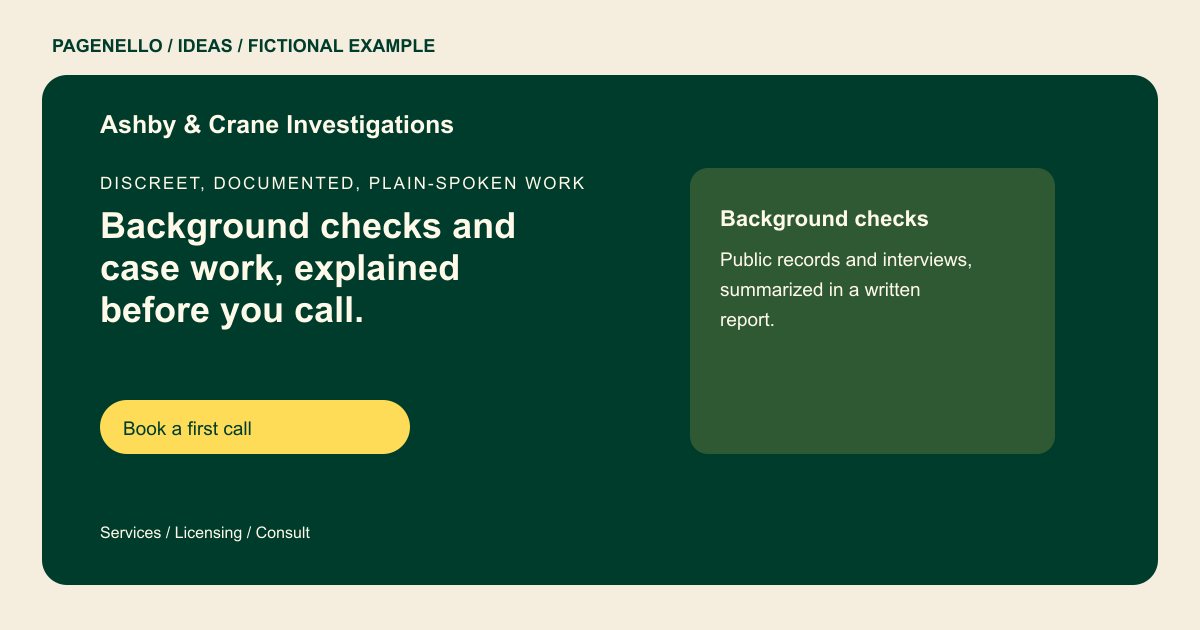
Discreet, documented, plain-spoken work
Background checks and case work, explained before you call.
Experienced investigators handle background checks, surveillance and process service. Book a first call to talk through your case.
Make the scope easy to recognize
Ashby & Crane groups its sample services into background checks, surveillance and process service. If your work centers on insurance or attorney referrals instead, arrange the page around those assignments and describe what you actually accept. Clear labels give someone a reason to call without asking them to disclose case details on the page.
Set expectations before a conversation
Beside the consultation action, outline what you discuss initially and when a written agreement comes into play. Avoid promises about findings, deadlines or confidentiality that you cannot substantiate. Ask visitors to reserve sensitive details for the intake channel you use for that purpose.
Show credentials accurately
The sample has a licensing navigation item. Replace it with the credentials and jurisdiction you can substantiate, and verify the advertising and licensing rules that apply to your practice. A quiet color palette and readable type can support a serious tone without relying on detective clichés.
Private investigators: ideas
| Idea | Use |
|---|---|
| Case-type directory | Give each investigation category a concise explanation so a prospective client can identify a relevant service. |
| Attorney-focused introduction | If referrals from law firms are your focus, explain the kinds of assignments you accept and how an attorney starts a discussion. |
| First-call pathway | Place a call button alongside a short account of the initial conversation; link to your existing scheduler if you use one. |
| Credentials in context | Pair the license information you provide with the states where you actually work, subject to applicable rules. |
| A restrained visual approach | Use typography, spacing and imagery you have permission to use rather than staged surveillance photos that misrepresent your work. |
Questions about private investigator websites
Is Ashby & Crane a real investigation client?
No. It is a fictional illustration, created to show how services, licensing and consultation links might be arranged. Use your own verified license details when adapting the design.
Should the website collect case files?
Keep sensitive documents in the intake system you choose. File uploads and a new intake form are outside the one-page package; a link can point to an existing tool.
What should a license section say?
Use your own accurate license details and check the rules for each jurisdiction and type of work. Do not copy the fictional sample as evidence of your credentials.
Can visitors schedule a consultation?
A button can lead to your existing scheduling service. Explain what a caller can expect without promising an investigation outcome. Keep sensitive case information out of public booking fields.