Masonry website design: one page with your projects, services and estimate call
Homeowners and builders searching for a masonry contractor want to see your finished work, the kinds of projects you take on, your license and insurance, and how to ask for an estimate. Pagenello builds that as one custom page for $590, with your project photos and a call button near the top. Your free first look at the top of the page comes before any payment.
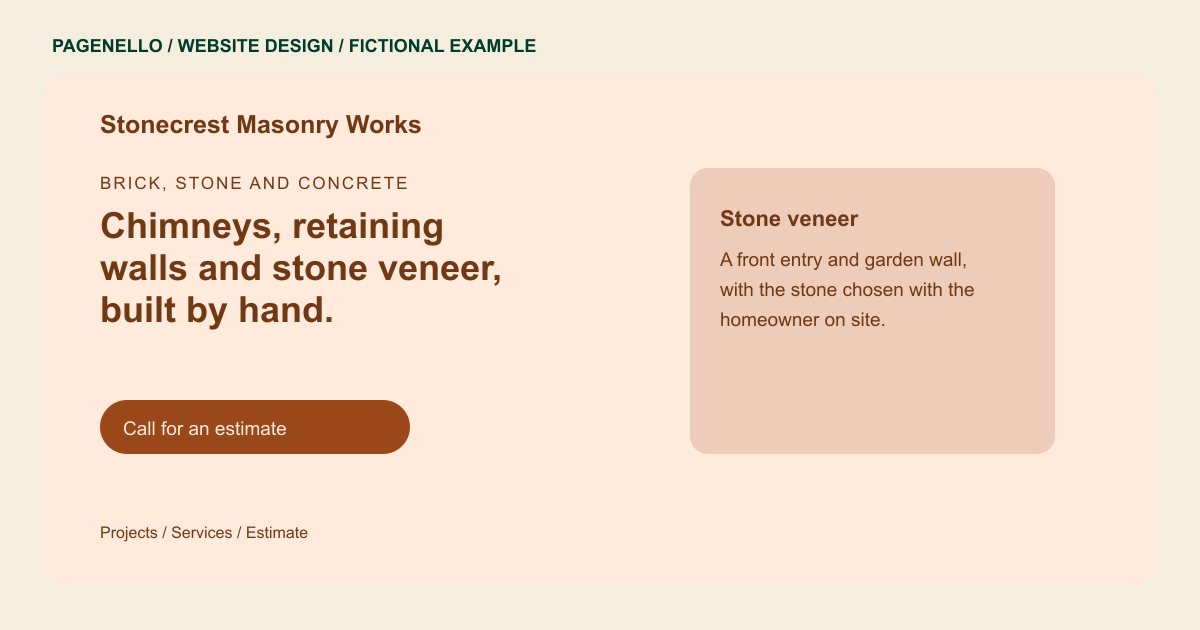
Brick, stone and concrete
Chimneys, retaining walls and stone veneer, built by hand.
Repointing, new brick and stone work for homes and small commercial jobs. Send photos and measurements by email for an estimate.
Plan your masonry website
What do masonry customers look for on a website?
A homeowner considering chimney repointing needs different information from a builder planning stone veneer. Describe the structures and materials your crew works with and whether you take repairs, new construction or both. Pair permitted project photos with captions identifying your part of the work. Explain your travel area and how you arrange an estimate. For a wall or chimney inquiry, invite the owner to describe its condition and location. Publish only license and insurance details you can substantiate.
| Customers look for | On your Pagenello page |
|---|---|
| Project photos | Photos of finished walls, chimneys, steps and veneers, grouped by job type, so a visitor sees the craft before the price. Distinguish mortar restoration from newly laid brick in each project caption. Use a close view of the joints alongside a wider view when both images are available for publication. Identify whether the photograph shows a repaired section or the original construction. |
| Services | The masonry work you do, such as brick, block, stone, chimney repair or concrete flatwork, listed in a short, plain list. Name the work your crew takes on, including whether stone veneer is installed or repaired. Separate brickwork, blockwork and stone services according to what your own team handles. A customer looking at a cracked step can ask your crew whether that kind of repair is within its scope. |
| Licensing and insurance | Your license and insurance details as text, plus any trade memberships you hold, shown exactly as they appear on your documents. Supply the issuing authority alongside any current trade credential. Review the wording of coverage details before placing them beside your business name. Include trade memberships only when your business currently holds them. |
| Service area | The places your crew actually covers, with a way to ask about a project outside your usual travel area. Say how a property owner can check coverage for a rural job. A general contractor can ask whether a planned site falls within your crew’s working area. A homeowner can give the project location before making arrangements for an estimate. |
| How to ask for an estimate | A call button and an email button, with a line saying what to send first, such as plans, photos or measurements. A builder can ask whether your crew needs drawings before discussing the scope. For an existing chimney, ask for the location and visible condition as a starting point for discussion. Where a site visit is part of your process, explain how the property owner can arrange it. |
Which tools can my page link to?
Your page can link to your existing estimating service, project portfolio and review profiles, with call and email buttons for new inquiries. Tell property owners whether your estimate begins with a conversation, photographs or a site visit. If you work from drawings, explain what your crew needs to review before quoting. Pagenello does not track masonry jobs or manage your schedule.
What does it cost?
$590 once. The first look is free. A portfolio page with more projects ($190) suits a crew with a long gallery of past work. $149 sets up your Google Business Profile, so your service area and job photos appear on Maps.
See the complete pricing and terms and how the first look works.
Questions from masonry owners
Should I show project photos before the services list?
A selection of permitted photographs can illustrate the materials and structures your crew works on. Captions can distinguish a repointed chimney from new stone veneer or a retaining wall. Send the details of each project so the descriptions identify your actual work.
Can customers request an estimate from my site?
A homeowner can contact you by phone or email to discuss the structure, its location and any measurements you need. Your page can also link to an estimating service you already use. Contact forms and file uploads are outside this package. For a damaged chimney, for example, explain how the owner can describe the affected area and arrange a conversation about the work.
Where do my license and insurance go?
Provide the exact license, insurance or trade membership details you want shown. Check applicable requirements for your work and service area. I use the information you supply and do not add unconfirmed credentials. Identify the issuing authority where relevant and keep each detail aligned with the current scope of your masonry work.
Do I need a page for each type of job?
One page covers your services, photos, service area and estimate buttons. A longer portfolio, or a page for each specialty such as chimney repair, is $190 each, when the work list needs room. Organize the main service list around the brick, stone or concrete work your crew actually performs, with project captions to match.
What does it cost to keep the site current?
The first year of Hosting & Care is included. After that, it is $149 (first 5 founding clients receive year two at no charge; renewal requires consent) a year if you choose to renew. Care Plus costs $390 a year and includes up to two small edits a month, which could include an eligible project photo.